
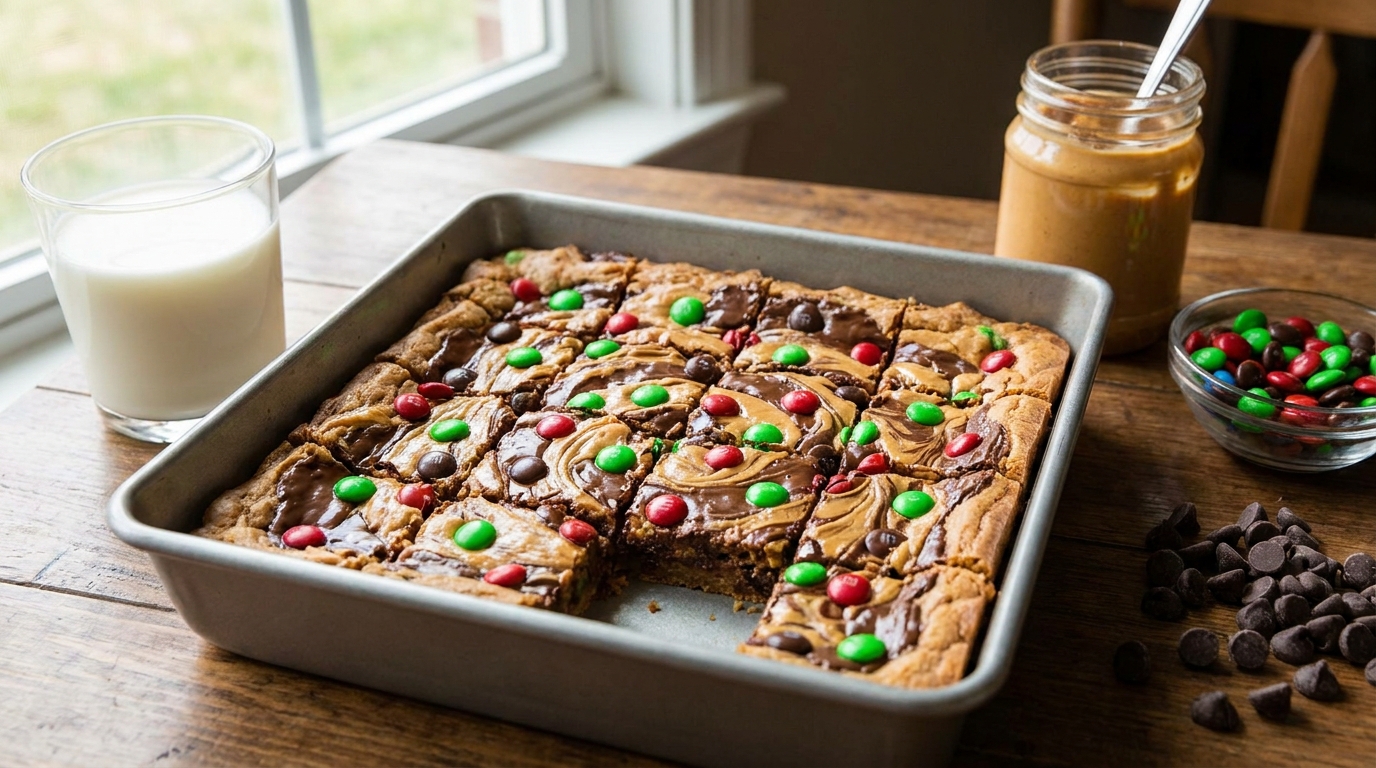
M&M Cake Mix Cookie Bars
Yellow cake mix, peanut butter, and a handful of M&Ms — the shortcut cookie bar that bakes up thick, chewy, and loaded with color.
Thank you for reading this post, don't forget to subscribe!
There’s a particular kind of baking shortcut that never gets old: starting from a box of cake mix instead of measuring out flour, baking soda, and sugar from scratch. This recipe leans all the way into that shortcut, turning a box of yellow cake mix into a thick, chewy cookie bar studded with peanut butter swirls, chocolate chips, and a generous scatter of colorful M&Ms.
Cake mix, peanut butter, and eggs form the base dough — no butter to soften, no sugar to cream, no waiting around for anything to come to room temperature except maybe the eggs. Fold in chocolate chips and M&Ms, spread it into a pan, swirl a bit of extra peanut butter and chocolate over the top, and bake.
What comes out of the oven looks like something from a bakery case — thick, golden, packed with color, with that soft, slightly underbaked-looking center that makes a cookie bar so much better than a regular cookie. It’s a genuinely easy recipe to reach for when you want something that looks like it took real effort but actually took about ten minutes of hands-on work.
This is the kind of recipe that shows up at school bake sales, birthday parties, and potlucks precisely because it hits every note people want from a cookie bar — chewy texture, rich peanut butter and chocolate flavor, and a candy-colored top that makes it look like a celebration all on its own.
A Little Bit of History
Cake mix as a baking shortcut has a long history in American home kitchens, dating back to the 1950s when boxed cake mixes first became widely available and marketed specifically as a time-saving alternative to baking from scratch. It didn’t take long before home bakers started using cake mix for things well beyond cakes — cookies, bars, and quick breads all began appearing in community cookbooks built around a box of mix as the starting point rather than flour and sugar measured individually.
Cake mix cookie bars specifically became a popular category of their own as bakers discovered that a box of cake mix, combined with just a couple of binding ingredients like eggs and oil or peanut butter, could produce a soft, chewy cookie dough with almost none of the usual measuring and mixing that a from-scratch cookie recipe demands. The formula proved endlessly adaptable — swap the mix flavor, swap the mix-ins, and you have an entirely different bar with the same reliable base.
The addition of M&Ms specifically nods to the broader tradition of candy-studded cookie bars, a category that includes everything from monster cookies to classic chocolate chip cookie bars loaded with extra mix-ins. Bright, colorful candy pieces scattered across the top of a warm, golden bar have become something of a visual signature for casual, crowd-pleasing baked goods, especially for kids’ parties and school events where a colorful presentation matters as much as the flavor.
Cake mix hacks in general have seen a real resurgence in popularity over the last decade or so, driven partly by a broader interest in nostalgic, easy baking that doesn’t require special equipment or advanced technique. Recipes built around a box of cake mix as a shortcut base — cookies, bars, even quick breads — tap into that same appeal: familiar, reliable results with minimal measuring and almost no risk of a baking failure.
Why This One Works
Cake mix already contains flour, sugar, leavening, and flavoring in carefully balanced proportions, which is exactly why it works so well as a cookie bar base with only a couple of additional ingredients. Peanut butter and eggs bind the dry mix into a thick, cohesive dough, while also adding richness and moisture that a plain cake mix alone wouldn’t have — the result bakes up denser and chewier than an actual cake, closer to a soft, thick cookie.
Peanut butter plays a particularly important structural role here beyond just flavor. Because it’s high in fat, it helps keep the bars moist and chewy rather than dry and cakey, which is a common risk with cake-mix-based cookies if too little fat is added to balance out the mix’s sugar and starch content. It also gives the dough enough body to hold its shape without spreading too thin in the pan, which matters for getting that thick, bar-like texture rather than a flat, spread-out cookie sheet.
The M&Ms and chocolate chips, folded in just before baking, hold their shape and color well under the oven’s heat, especially if a portion is reserved to press into the top of the dough right before baking rather than folding everything in beforehand — this keeps a good number of them visible and colorful on the surface, rather than sinking and getting lost inside the dough.
It’s worth noting that this style of shortcut baking has become especially popular as more home bakers look for reliable, low-effort recipes that still produce a genuinely impressive result. A box of cake mix removes most of the guesswork around ratios of flour, sugar, and leavening that trips up a lot of from-scratch cookie recipes, which makes this approach particularly forgiving for less experienced bakers or for anyone baking with kids.
What You’ll Need
- 1 box yellow cake mix
- 1 cup creamy peanut butter
- 2 large eggs
- 1 cup M&Ms, dividedSome folded in, some reserved for the top
- 1/2 cup chocolate chips
- 2 tablespoons peanut butter, for swirling on topOptional
A Closer Look at Each Ingredient
The cake mix. A standard box of yellow cake mix provides the flour, sugar, and leavening base for these bars. Yellow cake mix gives a classic, slightly buttery flavor that pairs well with peanut butter, though other flavors like chocolate or funfetti cake mix can be substituted for a different twist.
The peanut butter. A smooth, shelf-stable peanut butter blends most evenly into the dough and gives the bars their signature richness and chew. Natural peanut butter can work, but its higher oil content may make the dough slightly softer and more prone to spreading.
The eggs. Eggs bind the dough together and add moisture, helping the cake mix and peanut butter come together into a cohesive, scoopable batter rather than a dry, crumbly mixture. Room-temperature eggs incorporate a little more smoothly than cold eggs straight from the fridge.
The M&Ms and chocolate chips. Both add pockets of melted chocolate and bursts of color throughout the bars. Reserving a portion of the M&Ms to press into the top of the dough right before baking, rather than folding all of them in, keeps more of that bright color visible on the finished bars.
Equipment You’ll Need
A 9×13-inch baking pan lined with parchment paper is essential here, both for even baking and for making it easy to lift the finished bars out for slicing. A sturdy spoon or spatula works fine for mixing the thick dough, though a hand mixer can help if your peanut butter is on the firmer side. A butter knife or skewer is useful for creating the swirl pattern with the extra peanut butter on top.
How to Make Them
- Preheat and prepare. Preheat your oven to 350°F (175°C) and line a 9×13-inch pan with parchment paper.
- Mix the dough. In a large bowl, combine the cake mix, peanut butter, and eggs, stirring until a thick, cohesive dough forms.
- Fold in mix-ins. Fold in most of the M&Ms and chocolate chips, reserving a handful of each for the top.
- Spread into the pan. Press and spread the dough evenly into the prepared pan.
- Add the swirl and toppings. Warm the extra peanut butter slightly until pourable, then drizzle over the top and swirl gently with a knife. Press the reserved M&Ms and chocolate chips into the surface.
- Bake. Bake for 20–22 minutes, until the edges are golden and the center looks just set.
- Cool. Let the bars cool in the pan for at least 15 minutes before lifting out and slicing.
- Slice and serve. Cut into squares and serve at room temperature.


Troubleshooting Common Issues
My bars turned out dry and crumbly instead of soft and chewy. This almost always means the bars were overbaked. Pull them from the oven as soon as the center looks just set, even if it still seems slightly underdone — they’ll continue to firm up as they cool.
My dough was too thick to spread evenly in the pan. This can happen if your peanut butter was on the thicker side. Wetting your hands or a spatula lightly can help press and spread the dough evenly without it sticking to your tools.
My M&Ms lost their color or bled into the dough. This is more likely to happen with M&Ms folded into the batter rather than pressed on top. Reserving a good portion for the top, pressed in right before baking, keeps more of them vibrant and visible.
My bars sank in the middle after baking. This can happen if the bars were underbaked, or if the pan was removed from the oven too early and the center hadn’t fully set. Give them the full bake time and check for a just-set center before removing.
My bars stuck to the pan when I tried to lift them out. Line the pan with parchment paper, leaving overhang on the sides, to make removal much easier and avoid this problem entirely.
My bars taste too sweet. Cake mix already contains a fair amount of sugar, so if you find the finished bars overly sweet, try using slightly fewer M&Ms or chocolate chips next time, or opt for a less-sweetened chocolate chip variety to help balance things out.
Serving Suggestions
These bars are best served slightly warm or at room temperature, when the texture is at its softest and chewiest. A glass of milk is the classic pairing, cutting through the richness of the peanut butter and chocolate in a familiar, nostalgic way.
Because they’re colorful, sturdy, and easy to portion into squares, these bars are a natural fit for birthday parties, school events, and bake sales, where a fun, visually appealing treat goes a long way. They travel well at room temperature for a few hours, making them practical for potlucks and picnics too.
For a more polished presentation, cut the bars into smaller, bite-sized squares rather than large portions, and arrange them on a platter — the scattered M&M colors make for an especially eye-catching display without any extra decorating effort required.
These bars also make a fun baking project to do with kids, since the mixing and mix-in folding steps are simple and low-risk, and pressing extra M&Ms onto the top before baking is a genuinely enjoyable, hands-on step for younger bakers to take charge of.
A Few Ways to Make Them Yours
Chocolate Cake Mix Base
Swap the yellow cake mix for chocolate cake mix for a deeper, more chocolate-forward bar.
Holiday Colors
Use seasonal M&Ms in holiday-specific colors to match a particular occasion or party theme.
Extra Peanut Butter Swirl
Increase the amount of peanut butter swirled on top for a more pronounced peanut butter ribbon throughout.
Pretzel Addition
Fold in a handful of crushed pretzels along with the M&Ms for a salty, crunchy contrast.
Make-Ahead Tips
These bars can be baked a day or two in advance and stored covered at room temperature, which makes them a convenient option for parties or events where you’d rather not be baking the same day. The flavor and texture hold up well over a couple of days, and some bakers find the bars taste even better on the second day once the flavors have had more time to settle.
If you’re making these for a specific event, consider baking them the morning of or the day before, rather than several days in advance, to keep that fresh, chewy texture that makes these bars so appealing straight out of the pan.
A Note on Dietary Adjustments
This recipe can be adjusted for a few common dietary needs. For a gluten-free version, use a certified gluten-free yellow cake mix, which is widely available at most grocery stores — the rest of the recipe is naturally adaptable since peanut butter, eggs, and M&Ms don’t contain gluten. For a lower-sugar version, using a reduced-sugar cake mix can help, though the texture may be slightly different since sugar contributes to moisture and chew as well as sweetness.
This recipe isn’t naturally suited to a nut-free adaptation given how central peanut butter is to both flavor and structure, though a seed butter alternative like sunflower seed butter can sometimes be substituted with a similar texture, keeping in mind the flavor will be noticeably different from the classic peanut butter version.
For those managing portion sizes, these bars are rich and sweet enough that a smaller square than a standard bar works well — cutting the pan into 30 or more pieces instead of the standard 24 still delivers plenty of flavor while stretching the recipe further for a larger party or event.
Storage
Keep the bars in an airtight container at room temperature for up to 4 days — they hold their soft, chewy texture well. They also freeze nicely for up to 2 months; wrap tightly and thaw at room temperature before serving.
Common Questions
Can I use a different flavor of cake mix?
Yes — chocolate, funfetti, or even spice cake mix can all be substituted for the yellow cake mix for a different flavor twist using the same basic method.
Why did my bars turn out too thin?
This can happen if the pan used was larger than a standard 9×13-inch, spreading the dough thinner than expected. Stick to the recommended pan size for the intended thickness.
Can I use crunchy peanut butter instead of creamy?
Yes — crunchy peanut butter works fine and adds a bit of extra texture throughout the bars.
Can I double this recipe for a bigger batch?
Yes — double all the ingredients and use two 9×13-inch pans, or a larger sheet pan, adjusting bake time slightly if using a different pan size.
Why are my bars pale instead of golden on top?
This can mean the oven ran cooler than expected, or the bars need a few extra minutes of bake time. Check for golden edges and a just-set center as your visual cue for doneness.
Can I use plain chocolate chips instead of M&Ms?
Yes — you can use all chocolate chips if you prefer, or swap in any other candy-coated chocolate pieces you have on hand for a similar colorful effect.
Can I use peanut butter cake mix if I can find it?
Yes — a peanut butter-flavored cake mix, if available in your area, would intensify the peanut butter flavor throughout the bars, though the standard yellow cake mix combined with the added peanut butter already delivers a strong peanut butter taste.
Can I make these into individual cookies instead of bars?
Yes — scoop the dough into individual mounds on a lined baking sheet instead of spreading it into a pan, and reduce the bake time to about 10–12 minutes, watching closely since individual cookies bake faster than a full pan of bars.
One last thing worth mentioning: this recipe is a genuinely reliable one to keep on hand for last-minute treat requests, whether that’s a surprise bake sale, a spontaneous birthday celebration, or simply a craving for something colorful and sweet. With a box of cake mix and a jar of peanut butter already in the pantry, you’re only a bag of M&Ms away from a finished pan of bars.