
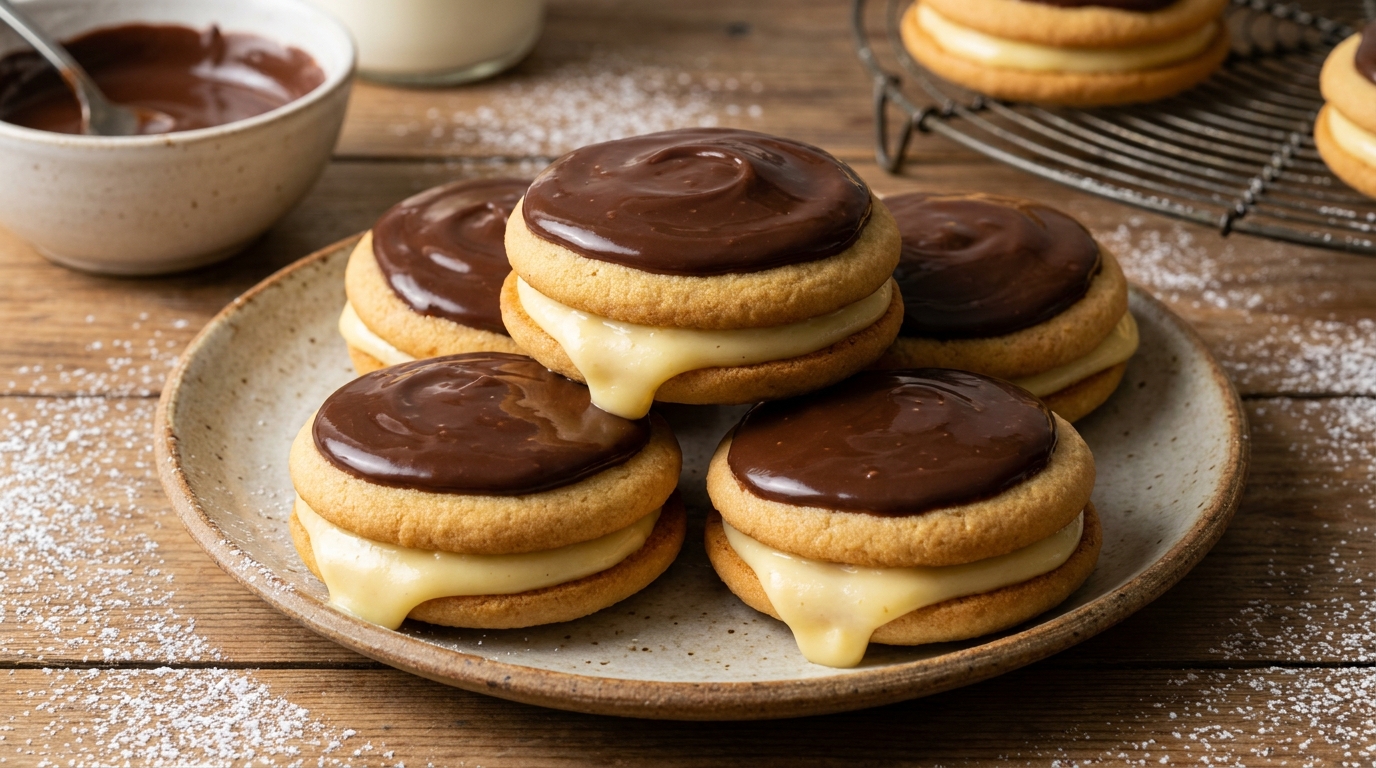
Boston Cream Pie Cookies
Soft vanilla cookies sandwiched around pastry cream, finished with a glossy chocolate drip — the classic dessert, shrunk down to a single bite.
Thank you for reading this post, don't forget to subscribe!
Boston cream pie is one of those desserts that takes real commitment — a sponge cake baked and cooled, a pastry cream made from scratch, a chocolate glaze poured over the top, all assembled into a single cake meant to be sliced and shared. This recipe takes everything people love about that dessert and shrinks it down into something you can eat with one hand.
Soft, cake-like vanilla cookies stand in for the sponge layers. A rich, creamy pastry filling goes in the middle, exactly the way it would in the full-sized cake. And a glossy chocolate glaze drips over the top, pooling slightly at the edges the way it does on the classic dessert it’s modeled after.
The result is a cookie that eats like a miniature cake — soft, filled, and finished with that same chocolate-vanilla combination that’s made Boston cream pie a beloved classic for well over a century, just in a format that doesn’t require a cake stand or a serving knife.
This is the kind of recipe that turns heads at a bake sale or dessert table, precisely because it takes a dessert everyone already loves and presents it in a completely unexpected, individually-portioned way. Nobody expects to bite into a cookie and find pastry cream and chocolate glaze doing exactly what they’d do on a full cake.
A Little Bit of History
Boston cream pie has a genuinely interesting history — despite its name, it’s actually a cake, not a pie, dating back to the mid-1800s when the terms ‘cake’ and ‘pie’ were used more loosely and interchangeably than they are today. It was created at Boston’s Parker House Hotel and quickly became one of the most iconic American desserts, eventually being named the official dessert of Massachusetts in 1996.
The classic recipe layers two rounds of sponge cake around a custard-style pastry cream filling, topped with a poured chocolate glaze that drips down the sides. That combination of light cake, rich custard, and glossy chocolate has proven durable enough to inspire countless adaptations over the decades — doughnuts, cupcakes, poke cakes, and now cookies, all borrowing the same three signature elements from the original.
Turning a layered cake into a cookie sandwich is a natural evolution of that adaptation trend, following the same logic seen in other cake-to-cookie translations. It takes a dessert traditionally served in slices at a table and turns it into something individually portioned and easy to share at a party, without losing any of the flavor combination that made the original so beloved in the first place.
The broader trend of shrinking beloved layered cakes and pies down into cookie or bar format reflects a genuine shift in how home bakers approach favorite desserts. Individually portioned treats are easier to serve at parties, don’t require plates and forks the way a sliced cake does, and photograph beautifully for sharing — all reasons this particular adaptation, along with similar cake-to-cookie translations, has become so popular in recent years.
Why This One Works
The soft, cake-like texture of these cookies comes from baking a dough enriched with a bit of extra moisture and fat compared to a standard crisp cookie recipe, giving them a texture closer to a small round of sponge cake than a typical cookie. This softer, more tender crumb is essential for the sandwich format to work — a crisp, crunchy cookie would crack and crumble under the weight of the pastry cream filling rather than holding together neatly.
The pastry cream filling relies on the same basic technique used in the full-sized Boston cream pie — egg yolks, milk, sugar, and a bit of starch, cooked gently until thickened into a rich, custard-like cream. Chilling it before assembly is important, since a warm filling would soften the cookies too much and make the sandwich difficult to hold together cleanly.
The chocolate glaze on top sets through simple cooling, the same way it would on the full cake, giving a glossy, slightly firm finish that contrasts nicely against the soft cookie and creamy filling beneath it. Pouring or spooning the glaze while it’s still warm and letting it drip naturally down the sides mimics the same visual signature the classic Boston cream pie is known for.
It’s also worth understanding why this recipe calls for a softer, more cake-like cookie dough rather than a standard crisp cookie base. A crisper cookie, similar to a classic sugar cookie, would crack under the pressure of being filled and stacked, and wouldn’t offer the same tender bite that makes the original Boston cream pie so appealing. The extra moisture and slightly higher fat content in this dough specifically mimics that soft, cake-like quality on a smaller, individual scale.
What You’ll Need
- 2 cups all-purpose flour
- 1 teaspoon baking powder
- 1/2 cup unsalted butter, softened
- 3/4 cup granulated sugar
- 2 large eggs
- 1 teaspoon vanilla extract
- 2 cups pastry cream or vanilla puddingHomemade or store-bought, chilled
- 1 cup semi-sweet chocolate chips, meltedFor the glaze
A Closer Look at Each Ingredient
The flour and baking powder. Standard all-purpose flour combined with baking powder gives these cookies their soft, slightly cake-like structure and lift, distinguishing them from a denser, chewier cookie base.
The butter and sugar. Softened butter creamed with sugar builds air into the dough, contributing to the cookies’ light, tender texture once baked. Make sure the butter is fully softened, not melted, for the best structure.
The eggs and vanilla. Eggs add moisture and richness, while vanilla extract reinforces the classic flavor profile that pairs so well with both the pastry cream and chocolate glaze.
The pastry cream. Homemade pastry cream gives the most authentic flavor and texture, closely mirroring the filling used in a traditional Boston cream pie. A high-quality store-bought vanilla pudding can be substituted for a faster version, though the texture will be slightly less rich.
The chocolate glaze. Melted semi-sweet chocolate chips, sometimes thinned slightly with a touch of cream or butter, create the glossy, drippy topping that finishes each cookie. Melt gently to keep the glaze smooth and pourable.
Equipment You’ll Need
A hand mixer or stand mixer makes creaming the butter and sugar considerably easier than working by hand, and is genuinely helpful for building the light, airy texture this dough needs. A saucepan and whisk are essential if making pastry cream from scratch, since it requires constant stirring over gentle heat. A piping bag, or a zip-top bag with the corner snipped, gives a cleaner fill than a spoon, and a small offset spatula or the back of a spoon works well for spreading the chocolate glaze evenly.
How to Make Them
- Preheat and prepare. Preheat your oven to 350°F (175°C) and line baking sheets with parchment paper.
- Cream the butter and sugar. Beat the softened butter and sugar together until light and fluffy.
- Add eggs and vanilla. Beat in the eggs one at a time, then add the vanilla extract.
- Combine dry ingredients. Whisk together the flour and baking powder, then gradually mix into the wet ingredients until a soft dough forms.
- Portion and bake. Scoop rounded tablespoons of dough onto the prepared sheets, spacing apart, and bake for 10–12 minutes, until just set and lightly golden at the edges.
- Cool completely. Let the cookies cool fully on a wire rack before filling — warm cookies will melt the pastry cream filling.
- Fill the sandwiches. Spread or pipe a layer of chilled pastry cream onto the flat side of half the cookies, then top with the remaining cookies to create sandwiches.
- Glaze and set. Spoon melted chocolate glaze over the top of each sandwich, letting it drip down the sides, then let set at room temperature or briefly in the fridge before serving.


Troubleshooting Common Issues
My cookies spread too thin and lost their shape. This can happen if the butter was too soft or melted rather than just softened, or if the dough wasn’t chilled before baking. Chilling the dough for 20–30 minutes before scooping can help cookies hold their shape better in the oven.
My pastry cream filling was too thin to hold its shape in the sandwich. This usually means the pastry cream needed more time to cook and thicken on the stove, or wasn’t chilled long enough afterward. Give it a full couple of hours in the fridge before assembling.
My chocolate glaze looked dull instead of glossy. This is chocolate bloom, usually caused by melting too quickly or at too high a temperature. Melt low and slow, stirring frequently, for the glossiest finish.
My assembled cookies fell apart when I picked them up. This can happen if the cookies were still slightly warm when filled, softening too much under the weight of the pastry cream. Always cool the cookies completely before filling and assembling.
My glaze ran off completely instead of setting in place. This usually means the glaze was too thin, either from overheating or from added liquid. Let it cool and thicken slightly before spooning it over the cookies for a cleaner, more controlled drip.
My pastry cream tasted eggy or had a strange texture. This usually means the eggs were added to the hot milk too quickly, causing them to scramble slightly rather than incorporate smoothly. Temper the eggs by whisking in a small amount of the hot milk first before adding the egg mixture back into the pan, whisking constantly.
Serving Suggestions
These cookies are best served the day they’re assembled, when the cookie is at its softest and the filling hasn’t had a chance to soften the surrounding cake too much. A light dusting of powdered sugar around the plate, echoing the classic Boston cream pie presentation, adds a nice finishing touch.
Because they’re rich and reminiscent of a full dessert in a single bite, these cookies pair beautifully with a cup of coffee or espresso, cutting through the sweetness of both the pastry cream and chocolate glaze. They also make a striking addition to a dessert table or bake sale, since the layered look immediately signals what flavor to expect.
For a more elegant presentation, arrange the finished cookies on a tiered stand or platter, letting the chocolate glaze drips show — that visual detail is part of what makes them look like a genuine miniature version of the classic cake rather than just another filled cookie.
These cookies also make a memorable addition to a dessert table specifically because so few people expect to see a classic layered cake reimagined as an individually-portioned cookie — the surprise factor alone often makes them one of the first things to disappear at a gathering.
A Few Ways to Make Them Yours
Chocolate Cookie Base
Swap the vanilla cookie for a chocolate cookie base for a deeper, more chocolate-forward version.
Boston Cream Whoopie Pies
Use a softer, more cake-like whoopie pie base instead of a firmer cookie for an even closer match to the original cake’s texture.
Mini Version
Make smaller cookies and use less filling for bite-sized, party-appropriate portions.
Espresso Glaze
Stir a touch of instant espresso powder into the melted chocolate glaze for a mocha-leaning depth.
Make-Ahead Tips
The cookies themselves can be baked a day or two in advance and stored at room temperature in an airtight container, unfilled, until you’re ready to assemble. The pastry cream can also be made a day ahead and kept covered in the fridge, which helps break the process into manageable steps rather than doing everything in one sitting.
It’s best to assemble and glaze the sandwiches within a few hours of serving, though, since the filled cookies are at their best texturally on the day they’re put together — waiting too long after filling can cause the cookies to soften more than ideal from the moisture in the pastry cream.
A Note on Dietary Adjustments
This recipe can be adapted for a few common dietary needs. For a dairy-free version, use dairy-free butter, a dairy-free pastry cream or pudding alternative, and dairy-free chocolate chips for the glaze — all three substitutions are widely available and work reasonably well as direct swaps. For a gluten-free version, a 1:1 gluten-free all-purpose flour blend can be used in place of standard flour, though the texture of the cookie base may be slightly different.
For those managing sugar intake, using a sugar-free pudding mix as a filling shortcut, along with a reduced-sugar chocolate for the glaze, can meaningfully lower the overall sugar content without significantly changing the assembly method.
For those managing portion sizes, these cookies are rich enough that a single sandwich makes a genuinely satisfying dessert on its own — there’s rarely a need to serve more than one per person, even at a gathering where other desserts are also on offer.
Storage
Keep assembled cookies covered in the fridge for up to 3 days — the pastry cream filling requires refrigeration once assembled. Unfilled cookies can be stored at room temperature in an airtight container for up to 5 days, or frozen for up to 2 months, then filled and glazed fresh when ready to serve.
Common Questions
Can I use store-bought vanilla pudding instead of homemade pastry cream?
Yes — a good-quality store-bought pudding works as a faster substitute, though homemade pastry cream gives a richer, more authentic texture closer to the classic dessert.
Why did my cookies turn out cakey instead of chewy?
This is actually the intended texture for this recipe — a softer, more cake-like cookie holds up better as a sandwich base and more closely mimics the sponge cake layers of the original Boston cream pie.
Can I make these ahead for a party?
Yes — bake the cookies and make the pastry cream up to a day ahead, storing them separately, then assemble and glaze the sandwiches a few hours before serving for the best texture.
Can I freeze the assembled, filled cookies?
Freezing isn’t recommended once filled, since the pastry cream doesn’t thaw well and can become watery. It’s better to freeze the unfilled cookies and assemble fresh when needed.
Why is my chocolate glaze too thick to pour smoothly?
This usually means the chocolate has cooled too much. Gently rewarm it over low heat or in short microwave bursts until it’s smooth and pourable again.
Can I pipe the pastry cream instead of spreading it?
Yes — piping gives a cleaner, more even layer and can also add a decorative touch if you use a piping tip to create a textured edge around the filling.
Can I use a boxed cake mix to make a shortcut version of the cookie base?
A cake mix cookie base can work as a shortcut, though the texture will be slightly different from a from-scratch dough — softer and a bit more delicate, which can make assembly a little trickier but still delicious.
How far in advance can I bake the cookies themselves?
The unfilled cookies can be baked up to 2 days ahead and stored at room temperature in an airtight container, or frozen for up to 2 months, then filled and glazed fresh whenever you’re ready to serve them.
One last thing worth mentioning: these cookies are a genuinely fun baking project for anyone who loves Boston cream pie but doesn’t want to commit to an entire layered cake. All the flavor, a fraction of the effort, and a format that’s easy to share, gift, or simply enjoy one at a time.