
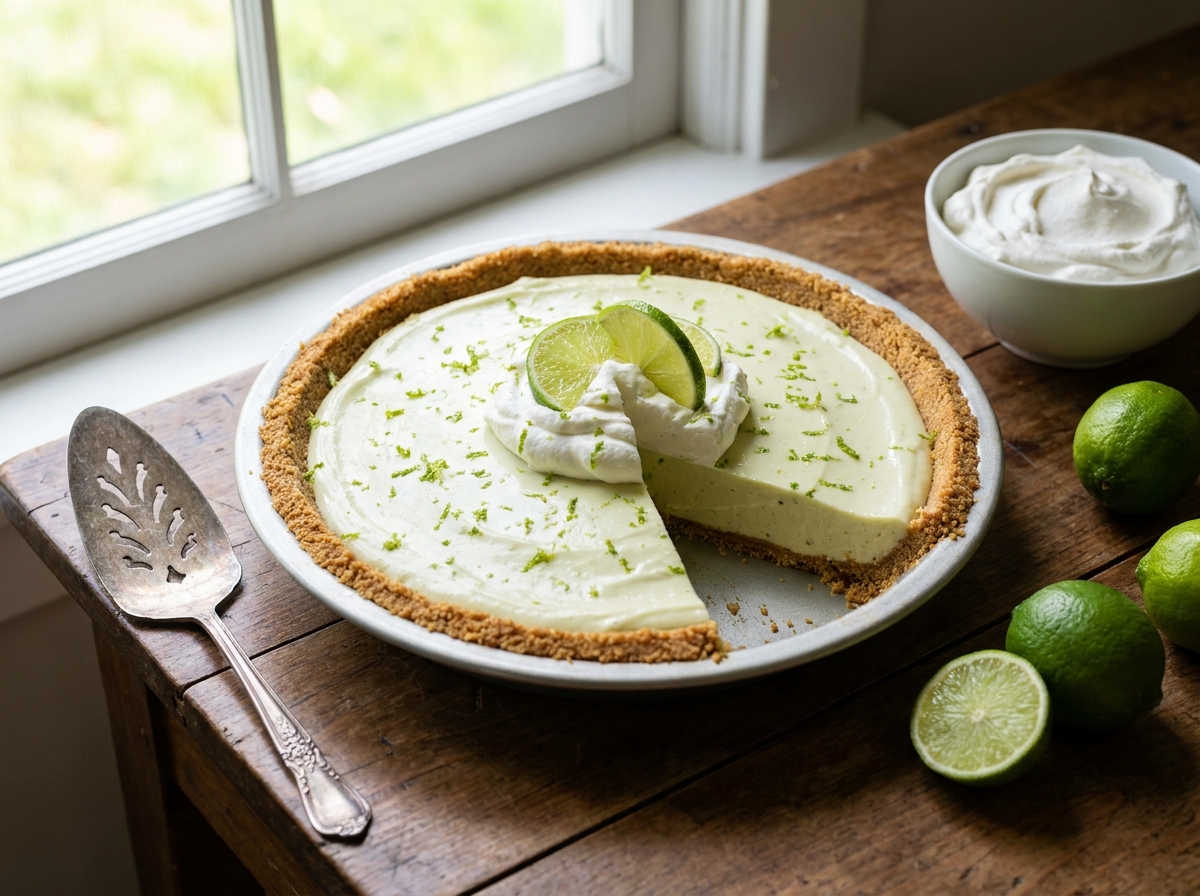
3-Ingredient No-Bake Key Lime Pie
Graham cracker crust, sweetened condensed milk, and key lime juice — no oven, no eggs, just a whisk and a fridge.
Thank you for reading this post, don't forget to subscribe!
Key lime pie has a reputation that outpaces its actual difficulty. It sounds like a Florida specialty that requires real technique — hunting down tiny key limes, juicing dozens of them by hand, carefully baking a custard until it’s set just right. This version strips all of that away and gets to the same bright, tangy, creamy destination with exactly three ingredients and zero time in the oven.
Sweetened condensed milk and key lime juice, whisked together until thick, poured into a graham cracker crust, and left alone in the fridge to set. That’s genuinely the entire process. No eggs to worry about curdling, no water bath, no risk of a cracked top or an underbaked center.
What sets in the fridge over the following hours is dense, pale green, and sharply citrus-forward, with that same tangy-sweet balance that’s made key lime pie a beloved American dessert for well over a century. Slice into it and you get a clean, custard-like cut, the kind that looks like it took far more effort than it actually did.
This is the pie to make when a craving for something bright and citrusy hits and the idea of turning on the oven feels like too much to ask, especially in the middle of summer. Ten minutes of whisking, a few hours of patience, and you have a genuine, crowd-pleasing dessert waiting in the fridge.
It’s also, worth saying plainly, one of the most forgiving pies in the no-bake category. There’s no temperature to hit, no visual cue to watch for in an oven, no timer to set. The chemistry that sets this filling does its work quietly in the fridge while you go about your day, and it does it reliably almost every single time.
A Little Bit of History
Key lime pie’s origin story is closely tied to the Florida Keys, where the small, intensely tart key lime — smaller, more aromatic, and more acidic than the common Persian lime found in most grocery stores — has grown for generations. Before refrigeration and reliable shipping made fresh dairy easy to access in the Keys, sweetened condensed milk was a pantry staple precisely because it didn’t spoil the way fresh milk would in the tropical heat. Combining that shelf-stable dairy with the region’s abundant key limes produced a pie that could be made reliably, without refrigerated ingredients, using only what was already on hand.
The chemistry behind that original pie turned out to be genuinely clever, even if it wasn’t understood in those exact scientific terms at the time. The natural acidity in key lime juice reacts with the proteins in sweetened condensed milk, thickening the mixture without any cooking or added eggs. Early versions sometimes included egg yolks for extra richness and structure, and many bakeries and home cooks still bake their pies briefly for food safety and a firmer set, but the essential reaction — acid meeting dairy, no heat required — is what made the original recipe possible well before anyone in the Keys had reliable refrigeration or an oven suited to consistent baking.
Key lime pie eventually became so closely associated with Florida that it was named the official state pie of Florida in 2006, and it remains one of the most recognizable regional American desserts, alongside things like Boston cream pie or New York cheesecake. Its popularity has spread well beyond the Keys themselves, with countless variations showing up across the country — some baked, some no-bake, some topped with meringue, some finished simply with whipped cream, as this version is.
The three-ingredient no-bake version specifically reflects a simplification that’s become increasingly popular in home baking over the past few decades, as more cooks look for ways to recreate beloved regional and restaurant desserts without needing specialized ingredients or techniques. Skipping the eggs entirely, and relying purely on the acid-based thickening reaction, makes this pie accessible to home bakers who might otherwise be intimidated by a more traditional baked custard filling.
It’s worth situating this pie within the broader family of American regional desserts that carry official state recognition, since key lime pie’s status as Florida’s official state pie says something about how deeply tied to place a dessert can become. Much like Boston cream pie in Massachusetts or the buckeye candy tradition in Ohio, key lime pie’s identity is inseparable from its geography — a dessert born out of what was practically available in a specific place at a specific time, that then grew into something with cultural weight far beyond its original, practical origins.
There’s also an ongoing, good-natured debate among key lime pie purists about whether a ‘true’ key lime pie should be baked briefly or left entirely no-bake, and whether it should be topped with meringue, whipped cream, or nothing at all. Regional bakeries across the Florida Keys have their own strong opinions on all of these questions, and there’s no single, universally agreed-upon ‘correct’ version — which is part of what makes it such a fun dessert to experiment with at home, since there’s genuinely no wrong way to make it as long as the core lime-and-condensed-milk flavor comes through clearly.
Why This One Works
The chemistry here is the same principle that makes several other classic no-bake pies possible — most notably lemon icebox pie, key lime pie’s closest cousin. Sweetened condensed milk is thick, rich, and already sweetened, straight from the can, but on its own it’s still pourable and loose. Key lime juice’s natural acidity reacts with the milk proteins as soon as the two are combined, causing the mixture to thicken almost immediately as you whisk, well before it ever touches the fridge.
That thickening reaction continues and stabilizes further as the pie chills, which is why patience matters here more than any active cooking step would. A pie pulled from the fridge too early will still taste great, but it won’t hold a clean slice the way a fully chilled pie will — the acid-dairy reaction needs the cold temperature to fully set into a firm, custard-like texture rather than staying loose and pourable.
Because there’s no egg and no heat involved anywhere in this process, there’s also essentially no risk of the classic custard pie failures — no curdling from too much heat, no cracking from rapid temperature swings, no undercooked center hiding beneath a set-looking top. The filling either thickens properly through the acid reaction, or it doesn’t fully set because it didn’t get enough chilling time — and giving it more time in the fridge almost always solves that.
It’s worth understanding, too, why key lime juice specifically produces a different result than regular lime or lemon juice, even though the underlying chemistry is the same acid-dairy reaction. Key limes are more acidic and more aromatic than common Persian limes, with a distinct floral note that’s part of what gives an authentic key lime pie its recognizable flavor. Bottled key lime juice, widely available in most grocery stores, captures that flavor reliably without requiring you to track down and hand-juice the tiny, seedy fresh key limes, which can be difficult to find outside of Florida and genuinely tedious to juice in the quantities a pie requires.
It’s also worth taking a moment to appreciate just how unusual this method is compared to most pie-making. The vast majority of pie fillings — fruit, custard, cream — rely on heat in some form, whether that’s cooking down fruit on the stovetop or baking a custard slowly in the oven. This filling sets entirely through a room-temperature chemical reaction between acid and dairy protein, followed by cold storage. It’s closer, in a strange way, to how cheese or yogurt sets than to how a traditional pie filling does, which is part of why it feels almost like a kitchen trick the first time you make it and watch the mixture visibly thicken as you whisk.
What You’ll Need
- 1 9-inch prepared graham cracker crust
- 1 can (14 oz) sweetened condensed milk
- 1/2 cup key lime juiceBottled or fresh
Whipped cream and lime zest make a simple, classic garnish for serving.
A Closer Look at Each Ingredient
The crust. A standard store-bought graham cracker crust works perfectly well here and keeps this recipe genuinely three ingredients from start to finish. If you’d rather make your own, combine about 1½ cups of graham cracker crumbs with a third cup of melted butter and a couple tablespoons of sugar, press firmly into a 9-inch pie dish, and chill briefly before filling — though at that point you’re technically adding ingredients beyond the core three, so it’s worth deciding upfront whether store-bought convenience or homemade flavor matters more to you for this particular bake.
The sweetened condensed milk. This is not the same product as evaporated milk, despite the similar-looking cans that often sit side by side on grocery shelves. Sweetened condensed milk is thick, already sweetened, and central to how this filling sets — double-check the label carefully before you buy, since grabbing the wrong can is one of the most common mistakes in this style of recipe.
The key lime juice. Bottled key lime juice is a genuinely reliable, widely available option and is what most home bakers reach for, since fresh key limes can be difficult to find outside Florida and the Gulf Coast, and juicing enough of the small, seedy fruit for a full half cup of juice takes real effort. If you do have access to fresh key limes, by all means use them — the flavor is slightly brighter and more aromatic — but bottled juice from a reputable brand produces an excellent, authentic-tasting pie without the extra work.
Equipment You’ll Need
This recipe asks for very little in the way of equipment, which is part of its charm. A large mixing bowl and a sturdy whisk are genuinely all you need — whisking by hand works perfectly well here, since the mixture thickens through a chemical reaction rather than through mechanical aeration, so there’s no real advantage to using an electric mixer. A rubber spatula helps scrape every bit of the filling out of the bowl and smooth the top once it’s poured into the crust. If you’re making your own crust rather than buying one pre-made, a 9-inch pie dish and a flat-bottomed measuring cup for pressing the crumbs firmly are useful additions.
How to Make It
- Whisk the filling. In a large bowl, whisk the sweetened condensed milk and key lime juice together until smooth and noticeably thickened, about 2–3 minutes.
- Pour into the crust. Pour the thickened filling into the prepared graham cracker crust and smooth the top with a spatula.
- Chill. Refrigerate for at least 3 hours, or ideally overnight, until the filling is fully set and firm to the touch.
- Garnish and serve. Top with whipped cream and a bit of lime zest just before serving, then slice while thoroughly chilled.


Troubleshooting Common Issues
My filling stayed loose and never thickened properly. This is almost always due to using a lower-acidity lime juice, or not whisking long enough for the reaction to fully take hold. Make sure you’re using genuine key lime juice, not regular lime juice, which has a different acidity profile, and whisk continuously for the full 2–3 minutes.
My pie didn’t set firm even after the full chilling time. Give it more time — this pie genuinely benefits from a full overnight chill rather than the minimum 3 hours, especially in a warmer kitchen or if your fridge runs on the milder side.
My filling tastes too tart or not tart enough. This can vary depending on the specific brand of key lime juice you use, since acidity and concentration differ between products. If you find the finished pie too tart, a touch more sweetened condensed milk next time will help balance it; if it’s not tart enough for your taste, use full-strength juice rather than a diluted version.
My crust turned soggy underneath the filling. This can happen if the filling was poured in while still very loose, or if the pie sat at room temperature too long before going into the fridge. Whisk until properly thickened before pouring, and refrigerate promptly once assembled.
My pie has a slightly grainy texture instead of smooth. This is uncommon with this method but can happen if the condensed milk and lime juice weren’t whisked together thoroughly enough at the start. A vigorous, continuous whisk for the first minute or two helps everything combine into a fully smooth mixture before it starts to thicken.
My filling separated slightly, with a thin layer of liquid on top. A very thin layer of separation after a day or two in the fridge is normal for an acid-set dairy filling like this one. Simply blot it gently with a paper towel before serving, and try to enjoy the pie within the first few days for the best texture.
My finished pie tastes overly artificial or one-note. This can happen with certain lower-quality bottled key lime juice brands that rely heavily on added flavoring rather than genuine key lime extract. If this bothers you, look for a brand that lists key lime juice as close to the top of the ingredient list as possible, or seek out fresh key limes if they’re available in your area.
My pie’s crust separated slightly from the filling at the edges. This is largely cosmetic and can happen simply from the natural shrinkage of the crust as it chills alongside the filling. It doesn’t affect flavor or texture, and a bit of whipped cream piped around the border easily disguises it if presentation is a concern.
Serving Suggestions
This pie is bright and rich enough to serve entirely on its own, chilled straight from the fridge, but the classic finishing touch is a generous layer of freshly whipped cream over the top, along with a bit of lime zest or a thin lime wheel for garnish. That simple topping is traditional for a reason — the light, airy cream softens the tang of the filling and adds a visual contrast against the pale green pie beneath it.
Because key lime pie is such a distinctly refreshing, citrus-forward dessert, it works especially well after a rich or heavy meal, where something denser and more chocolate-based might feel like too much. It’s a natural choice for summer gatherings, barbecues, or any occasion where a lighter, brighter dessert fits the mood better than something heavier.
This pie also travels reasonably well for a couple of hours if kept cool, which makes it a solid option for potlucks and picnics, provided you can keep it chilled along the way. For a more polished presentation, pipe the whipped cream in small rosettes around the edge of the pie rather than spreading it across the whole surface, and finish with thin lime wheels arranged around the border.
A cup of iced tea or a cold glass of lemonade pairs naturally with this pie, echoing the same bright, citrusy character. For an after-dinner setting, it also holds its own alongside coffee, since the acidity of the filling cuts nicely through any lingering richness from an earlier course.
This pie also makes a thoughtful, low-effort contribution to a larger holiday or celebration dessert table specifically because its bright, pale green-yellow color and citrus-forward flavor offer such a clean contrast to the heavier, often chocolate-dominated desserts that tend to fill most spreads. It gives guests a lighter option without asking you to plan and execute an entirely different style of dessert.

A Few Ways to Make It Yours
Toasted Coconut Topping
Sprinkle toasted coconut flakes over the whipped cream for a tropical finishing touch that pairs naturally with the lime.
Graham Cracker Crumble
Add an extra sprinkle of crushed graham crackers over the top along with the whipped cream for more texture.
Meringue Topping
Spread a layer of meringue over the chilled, set pie and toast briefly under the broiler for a more traditional, baked-style finish.
Individual Cups
Layer crushed graham crumbs and the filling into small jars or cups for portioned, no-slice servings, perfect for a party.
Make-Ahead Tips
This pie is genuinely built for making ahead, since it needs a substantial chilling period regardless of when you plan to serve it. It can be made up to two days in advance and kept covered in the fridge, which makes it a reliable choice for holidays, dinner parties, or any occasion where oven time and prep time on the day of serving are already stretched thin.
If you’re adding a whipped cream topping, it’s best to hold off until closer to serving time, since whipped cream can lose some of its structure and start to weep a bit of liquid if it sits on the pie for too long before serving. If you know you’ll need the pie ready well in advance, consider keeping the whipped cream separate in its own container and adding it just before the pie goes to the table.
For anyone hosting a larger gathering, this recipe also scales up reasonably well — doubling the filling ingredients and using two prepared crusts lets you serve a crowd without any change to the basic method or chilling time.
A Note on Dietary Adjustments
This recipe can be adapted for a few common dietary needs with a little care. For a lower-sugar version, a reduced-sugar sweetened condensed milk can be substituted, though the texture and set may be slightly different since sugar content affects how firmly the filling thickens. For a gluten-free version, simply use a certified gluten-free graham cracker crust — the filling itself contains no gluten at all.
Full dairy-free adaptation is more difficult with this particular recipe, since sweetened condensed milk is central to both the flavor and the structural set of the filling. Dairy-free condensed milk alternatives do exist on the market and can be substituted, though the acid-based thickening reaction may behave somewhat differently depending on the specific product, so it’s worth trying a small test batch first if you haven’t used a particular brand before.
For those managing portion sizes, this pie is rich enough that a standard eighth-slice portion is genuinely satisfying — cutting slightly smaller slices, particularly if serving alongside other desserts at a larger gathering, is a simple way to stretch this pie further without anyone feeling shortchanged.
It’s also worth noting that key lime juice, whether fresh or bottled, is a genuine source of vitamin C, which is a small but real nutritional upside to a dessert that’s otherwise, understandably, mostly about sugar and dairy. This isn’t a reason to consider the pie health food by any means, but it’s a nice bit of context for anyone curious about what’s actually in the filling beyond just sweetness.
Storage
Keep the pie covered in the fridge for up to 5 days — the acid-set filling holds up well chilled without any risk of spoiling the way an egg-based custard might. This pie doesn’t freeze particularly well due to the dairy-based filling, which can separate and lose its smooth texture once thawed, so it’s best enjoyed fresh within the first several days.
Common Questions
Can I use regular lime juice instead of key lime juice?
You can, and the pie will still taste good, but it won’t have quite the same distinctly tart, aromatic flavor that genuine key lime juice provides. Regular lime juice is less acidic and slightly less floral, so the finished pie will taste milder and a touch less complex.
Why does the lime juice thicken the condensed milk?
The acid in the lime juice reacts with the proteins in the sweetened condensed milk, causing the mixture to thicken without any cooking or added eggs — the same basic chemistry used in classic lemon icebox pie.
Can I use bottled lime juice from concentrate?
Yes — most bottled key lime juice on the market is made from concentrate and works perfectly well in this recipe. Just make sure it’s labeled as key lime juice specifically, not a generic lime juice product.
How do I know when the pie is fully set and ready to slice?
The filling should feel firm to a light touch and hold a clean edge when you make the first slice, rather than sinking or spreading. If it still feels soft or slightly jiggly, give it more time in the fridge.
Can I make this pie in individual servings instead of one full pie?
Yes — layer crushed graham cracker crumbs and the filling into small jars or cups for individual, portioned servings, which also chill and set slightly faster than a full pie due to their smaller size.
Why is my pie’s color pale yellow instead of green?
This is completely normal and doesn’t affect the flavor at all. Authentic key lime juice actually produces a pale, custard-yellow filling — the vivid green color often seen in key lime pies at restaurants and bakeries typically comes from added food coloring, not from the natural juice itself.
Can I freeze this pie for longer storage?
Freezing isn’t recommended for this particular filling, since the dairy-based mixture tends to separate and lose its smooth, sliceable texture once thawed. This pie is best made and enjoyed within about five days for the best quality.
Is this pie safe to eat without baking, since it contains raw lime juice and no eggs?
Yes — because this filling contains no eggs and relies purely on the acid-dairy reaction to set, there’s no food safety concern with the no-bake method the way there might be with a raw-egg-based dessert. Sweetened condensed milk and key lime juice are both shelf-stable, pasteurized products.
Can I add cream cheese to this recipe for a richer, more cheesecake-like filling?
Yes — some bakers fold in a block of softened cream cheese along with the condensed milk and lime juice for a denser, tangier, more cheesecake-style filling, though this moves the recipe beyond its original three-ingredient simplicity. If you’d like to try it, beat the cream cheese smooth first before whisking in the other two ingredients.
Why do some key lime pie recipes call for baking the filling briefly, even though this one doesn’t?
A short bake, often just 10 minutes or so, is sometimes used to pasteurize any egg yolks included in a richer filling variation, or simply to help the filling set a bit firmer and more quickly than chilling alone would. Because this particular recipe contains no eggs, that step isn’t necessary here — chilling alone sets the filling completely.
Can I make a larger batch of this pie for a bigger gathering?
Yes — this recipe scales up cleanly. Doubling the condensed milk and key lime juice, and using two prepared crusts, lets you serve twice as many people without any change to the method, ratios, or chilling time.
What’s the difference between key lime pie and regular lime pie?
The primary difference comes down to the lime variety used. Key limes are smaller, more aromatic, and noticeably more acidic than the common Persian limes sold in most grocery stores, giving key lime pie its distinctively sharp, floral tang that a pie made with regular limes won’t quite replicate, even though the basic method and texture would be very similar.
One last thing worth mentioning: this pie is a genuinely reliable recipe to keep in your back pocket for the moments when you want a real, impressive dessert without any of the usual baking risk. A can of condensed milk, a bottle of key lime juice, and a store-bought crust are often already sitting in a well-stocked pantry, which makes this one of the most spontaneous, last-minute-friendly pies you can make.